FLAGSHIP_DIAGNOSTIC
Sentiment & Bias Mapping
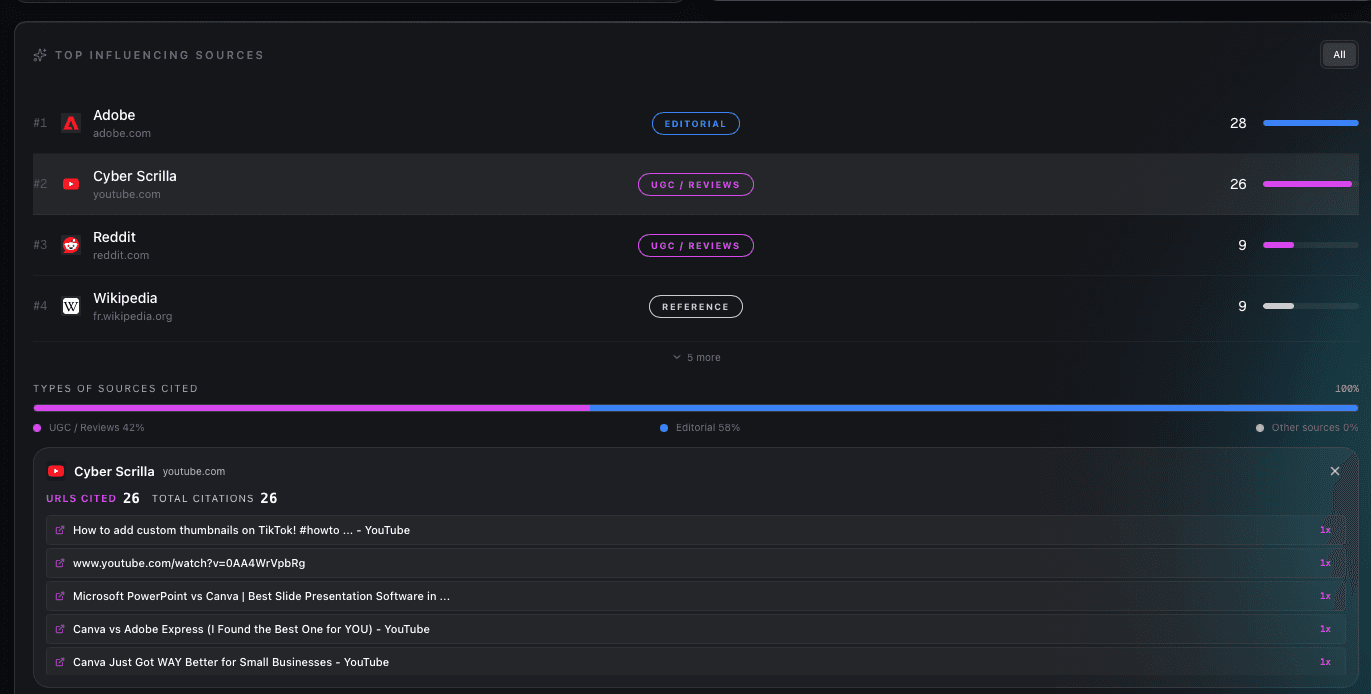
Understand the underlying bias of different LLMs toward your product category. Lucid maps technical sentiment and source influence across major model responses.
Real-time tracking
Historical comparison
Secure your market position. Lucid provides the structural visibility, surgical precision, and validation loop required to dominate generative discovery.
RUN_ID: DECISION_LAYER_AUDIT
One lost buying prompt can still route high-intent pipeline to better-cited competitors.
AI visibility
67/100
Pipeline at risk
$184K
Prompt leaking decisions
high intentbest CRM for B2B onboarding teams
HubSpot still leads because its pricing, proof, and comparison language are easier for answer engines to cite.
Est. category demand
18.2K/mo
Pipeline at risk
$184K/qtr
Current leader
HubSpot
Current answer set
3 brands citedWhat Lucid would fix first
first movePublish one comparison page around the lost buying prompt
Engine spread
recommendation sharecompetitor-led
partial presence
not shortlisted
WHY NOW
While others chase dying keywords, the winners are shaping how AI models narrate their category.
Buyers are shifting from search bars to AI summaries. If your product is not the recommendation inside ChatGPT, Google AI, or Perplexity, you can keep impressions while losing the decision.
01 — SIGNAL
34.5%
Ahrefs found that the top organic result gets about 34.5% fewer clicks when an AI Overview is present. Your traffic is already being cannibalized upstream.
SOURCE: AHREFS
02 — SIGNAL
8% vs 15%
Pew Research showed users click far less when the AI summary resolves the question first. You increasingly need to own the answer, not only the blue link.
SOURCE: PEW RESEARCH
03 — SIGNAL
1.5 BILLION
Google said AI Overviews had scaled to more than 1.5 billion users. For founders, that means AI discovery is already a live distribution layer, not a future bet.
SOURCE: GOOGLE
JOIN 2,400+ FOUNDERS ALREADY IN THE LOOP
SYSTEM_STATUS
REAL-TIME ARCHITECTURAL ANALYSIS OF GLOBAL LLM ECOSYSTEMS & SEMANTIC POSITIONING.
Global Reach Metrics
Semantic Alignment
Conversion Vectors
Bias Identification
Customer Validation

Eric Depoorter
President & CEO Europe
LA BOÎTE ROSE — FAMILY SERVICE
STRUCTURAL_SHIFT.LOG
Legacy search strategies are failing in the age of LLMs. Lucid solves the core visibility problems of the modern SaaS landscape through structural semantic mapping.
Zero insight into why AI models are recommending competitors instead of your solution in natural language queries.
Your high-value technical documentation is being misread or ignored by generative spiders due to semantic gaps.
Marketing teams cannot track conversions originating from answer engines like ChatGPT or Claude.
Real-time heatmaps showing your brand's presence across major generative engines and LLMs.
Explore dashboard_Automated auditing that reveals exactly what terminology and proof LLMs still need to index your brand properly.
Run audit_A structural loop that maps the path from AI response visibility to demo creation and commercial intent.
See pricing_DIAGNOSTIC_SUITE
Understand the underlying bias of different LLMs toward your product category. Lucid maps technical sentiment and source influence across major model responses.
Where do you appear when buyers ask for "Top 5 CRM tools"? Track your position in comparative lists through structural query mapping.
Analyze which technical docs, pages, and claims AI engines are using as their "ground truth" source for your brand.
Identify the prompts where competitors are winning the AI recommendation and prioritize the proof and positioning needed to displace them.
View deep-dive_Join the elite B2B brands securing their place as the ground truth for the next generation of SaaS discovery.
FAQ_REPOSITORY
GEO is the discipline of making your brand understandable, defensible, and citable inside AI-driven discovery surfaces such as ChatGPT, Google AI, Claude, and Perplexity. It combines structure, semantics, evidence, and source shaping so your company can become a recommended answer instead of just another indexed page.
SEO still focuses on crawlability, ranking, and click capture. GEO works one layer higher: answer-level visibility, source influence, semantic clarity, and proof quality. Lucid measures whether models can explain your product correctly, trust the right pages, and mention you when buyers ask comparative questions.
Yes. The audit is the starting point, not the product. Lucid helps teams move from diagnosis into remediation with truth-layer analysis, evidence gap mapping, page and doc fixes, structural directives, monitoring, and re-verification so changes can be shipped against what models actually reward.
Increasingly, yes. As Google folds AI Overviews and answer synthesis into search, the signals overlap more: clean information architecture, strong entity clarity, consistent claims, and citable proof tend to help both GEO and organic performance. GEO does not replace SEO, but the two are no longer separable.
Lucid is built to compare visibility and narrative control across major answer engines rather than treating AI discovery as a single channel. That includes surfaces such as ChatGPT, Gemini, Perplexity, Claude, and emerging AI search interfaces, so teams can see where they are strong, missing, or being displaced.